Tuesday, February 3, 2015

Chine ideas, round stern details,

Here's some sketches of my current thinking on my lower lifting Chines, spray strakes, and a round transom.

This is how I see certain Chines working. When running your skiff and others look at how the water flows out from under the skiff when at all angles of trim. Do this in flat water to get a good view and then in rough water to see what really happens. All small skiffs suffer from the fact that they cannot travel fast enough to get away from beam sea spray blow back. To help in this I feel you need to help direct the spray away from the hull in a downward and hopefully aft direction.

 
I use this reverse spray strake to direct the spray down. Small light skiffs do not need any lift from the middle of the skiff forward. You will have to use trim tabs to get the bow down so why have these lifting  strakes there? In a solid glass bottom they do add some strength but at the cost of being wet.


  Station # 1
Starting at the stern going forward my latest ideas on my bottom lifting - keel strake .
The added keel drawn could be added to the HBBWs Guide and 17.8 and others as they have enough vee to the bottom that will allow these mini keels to not drag.


Station # 2 


Station # 3 
I feel by softening the inner chine it will keep the water flowing closer to the hull and that will  
Get it to be directed downward and lower. Do this starting at the helmsman seat. Aft you need sharp edges to get speed and planning ability. All the spray there is going away from you. 


Station # 4 


A free hand sketch of how this really round transom will work. The bottom stern edge is straight but all above is really very round and soft. I do not like trim tab pockets as too much work . These reverse outty Pockets will be easy for installation as they can fit all kinds of trim tabs and sizes. 


Lots of lines , and angles here. Hope you can see what's happening here.

 
In reality it's all very simple but on paper its a lot of lines. To remove the boat hull from the mold you will pull the hull out like taking off a shoe. The only thing is the stern sheer flange downturn will not be there to stop the hull. This is no big deal as it will be under the deck flange.

Hope this helps in thinking of different ways of getting rid that damn spray and making for a quiet stern for the purists out there.
 

SABA ISLAND climbing and diving

 Rachel and Bequia our sea dog have finally made it back onboard the Hogfish Maximus joining us In St. Martin. Our daughter Kalessin and her boyfriend Pavlo flew in for a surprise visit so the boat was full. Kalessin has been working on mega yachts since high school and was in between jobs- boats. She met Pavlo over a year ago and they are very much a couple now. While she was here she was to have her 25 th birthday and also celebrate the fun fact that she spent her first Christmas in St. Martin on board our First Hogfish. Lots has changed since then.


Hogfish at anchor on Christmas Day 1990 in St Martins Philipsburg bay with a second hand mainsail made from Jim Melchors Alerts old main. This is the only time I ever had it up.

Pavlo is from Zimbabwe in South Africa . He had just finished his test for Officer of the Watch and the two of them were in Ft. Liqueurdale looking for a yacht job that they both could work on instead of being two yachts passing in the Chichi night. I had not met Pavlo in person yet only via Skype.
It's pretty amazing what determined young people can accomplish today in work and travel. Kalessin has been to 45 country's so far on her own and Pavlo too. 
The three of us had a few days together before rachel was to arrive. Pavlo grew up in a very interesting country with a very unsteady past as far as economics go. He is a very grounded individual because of this and to get on my good side right off the bat he slipped me a few $ to cover the expenses on board  for the next few days.


 Nice guy giving me 30 trillion Zimbabwe dollars . These bills are real. I just need 30 trillion more to pay for dinner.

The day before Rachel arrived our old sailing mates Tim And Gayle Evans sailed in with their Trintella 43' ketch " Wild Bird" from Barbuda having just crossed the Atlantic from their home port in England. We had met them ten years before on the island of Madera. They had just rescued our dinghy from its own personal Atlantic crossing as Kalessin had not tied it up properly . We next met up a week later when we anchored in the little bay on Graciosa island in the Canary Islands. Tim and Gayle being at bit younger than Rachel and I give us so much energy with their enthusiasm for life. Weather it be projects, work, hiking , swimming, just being around them is life energizing. They were sailing on an old Prout 37' catamaran named " Grace May". We love to hike and mountain climb as do they . We ended up sailing in somewhat of company as their catamaran was faster than the Hogfish with us arriving behind them but with the added benefit of having them giving us all the scoop on what was up having arrived earlier . To even out the playing field in racing from one island to the next and across the Atlantic we came up with a score chart to add up upon arrival. This gave us a fighting chance to beat Grace May at times. Points were awarded and subtracted based on what was seen or done on the trip. Points were given for how many fish caught, whales seen, ships counted, birds named, the best tan, cakes cooked, and so on with points taken away for motoring, we only had an outboard , but they had a proper inboard. Points were also taken away for any yelling , so with our teenage daughter she cost us a few points in that department. This system worked out quite well as it was so much fun to go over all that we had seen and done when we next met up at our next landfall. Grace May always won over all but we were  very close behind. Grace May took 15 days to cross the Atlantic to our 18 days but when all was tallied up we only lost by 12 hours. 
Last summer I got an email from them saying that they were to be sailing back across the Atlantic in their new boat having changed over to a monohull to carry more stuff. The new boat was built in Holland 30 some years ago and had teak decks that were worn out. "  Would I be interested in replacing some parts with new teak and removing all the rest and glassing over and painting ?"
" Sounds  great to us". So the plan was for us to sail down to meet up with them after hurricane season when they arrived over on this side of the pond. We would then go back to our routine of chasing them from port to port to mountain climb , hike and just adventure together. They were to store the " Wild Bird" in Grenada for the hurricane season on land and fly back to England to work over the summer while I did the job on the boat. Then after the hurricane season with both our boats all painted and ready to sail the plan is to sail down wind to Panama to explore via the ABC islands. From there we would sail on up island hopping to Cuba which has just opened up to me as an American and then on back home to our place in the Bahamas. At this point I would crew for  them back across the Atlantic to England or they would leave their ketch behind our house in Pelican Bay for the hurricane season for us to look after. As our kids are grown now we can just about do what ever we want so our plans will most likely detour a bit here and there. With Cuba being open I feel I will be sailing there for quite awhile as it has everything the carribean has but so much more. Plus my family history on my dads side goes back hundreds of years.


Wild Bird passing us to leeward.

With our kids aboard we immediately took off sailing to see SABA.


Motoring into the lee of SABA with a cloud that had run aground on top of the peak giving us shade.


Clouds gone with one of the peaks above that we would hike up to .


Rachel and Bequia at the bottom of the bottom.


In town having a tea with Tim , Gayle and their pattengale Terriers Pip and Gem. Rachel in white hat. Tim and Gayle run in endurance races back home in all weathers so we're all kitted out in the right shoes and clothes. I normally hike up hill barefoot and then put my floppys on going down hill if it's rocky.
This is the Town of Windward. Very nice place. All the roads were made- poured in concrete. I can only imagine that a lot of this infrastructure was subsidized by Holland at one time. When hiking up the mountain you could see all the hand made terraced walls in rock that were once the subsistence level of farming that went on before tourism was invented.  


Starting the climb to the top of SABA with its 1064 steps and muddy trails going right up to 2987' to the top.


Going up


Steps , steps, and more steps....


One small peak achived . Our dogs go with us on the islands that allow vaccinated dogs to go ashore on.


Rachel , Pavlo, Kalessin, Gayle and Tim with The town of Windward below. Only part way up.


Windward


A bit slippery and muddy at times.


Bequia looking for the others to catch up. That an old growth Mahogany tree in the background. Kinda rare as all the original trees lower down would have been cut down to make room for farming ,lumber, and charcoal for cooking. Most trees you see near the water are only recent growth. 


Rachel standing on top of the peaks marker. This island was a part of the Dutch empire once soo....they claim this to be the highest mountain in Holland.


Looking down into the abyss with constant clouds passing by. Very cold at times. Almost 2,000' strait down from here.


This is the town of " Bottom" with our boats , moored just over beyond the vee in the mountains. 

Pavlo and Kalessin went scuba diving the next day doing two dives ,one to 40 meters. They are both dive masters . We snorkeled around with the water being perfectly clear with fish and turtles about and not sacred at all it being the island is all a park . This was so nice to experience seeing every thing so relaxed. The Bahamians need to think real hard about the future of their waters as its under huge pressure now and could end up like the islands down here that waited to late to stop all the killing.

Pavlo and Kalessin were continually networking via the net during this trip and landed a job where the two of them would be working on the same yacht so it was back to St Martin so they could jet off to their next adventure. What a life for them. 

I'am saving the 30 trillion $ that I got from Pavlo to keep in my wallet in case I need to get out of trouble down here. Could come in handy.

Thursday, January 15, 2015

MEGA YACHT NAMES

These Mega yacht owners have a real sense of humor when naming their yachts.
Here's a few I think I saw,

- American Bailout $
-Wall Street Goodbyes
- Born Right
-Severance Package
-Did Well
-Insider
- Hali Brr Ton
-Buyout
- Entitellment Queen
- They'ell Nev Er No
- Exon Advantage
-Oilish
- Oliarks Pleasure
- FU Maximus  
- 1% Ter
-Hogfish Maximus


Kidding aside, what gives me great pleasure in seeing these incredible expressions of talented skilled designers and craftsmen is knowing that through great weath and success in how ever it was achieved  
 it takes everyday people to make these creations come to life. Having a floating testimony to your ability to make it happen weather you have paid the bills, designed the boat, or have the skills to get it built is what makes these Yachts so magnificent .
I still think the coolest thing to have is your own designed and built floating flying carpet.

Monday, January 12, 2015

Some more Hells Bay Boatworks photos and history and other past history

Today taking a break from a design commission I'am drawing up, a small house, I have found these photos from my past. It's very rolly and windy today with guts in the 30s . Even anchored well behind and what would seem to be the lee in these big islands the anchorages here can be uncomfortable. You have to imagine getting in and out of the bath tub and that's how the seas make it around the corners of these islands. 
This is Jack Nicklaus's  yacht " The Bear" with three HBBWs skiffs on deck.We knew a Captian that knew Jacks Captian that said Jack was interested in our skiffs. I took three of our skiff models down to West Palm to meet up with Jack.
We spent half a day riding around in each skiff with me trying to show him how to drive them. At first he just did not understand that you had to run these skiffs like a sports car. Once he got the hang of it he loved our boats. He orderd all three models. I had a great time with him and meeting his wife.
He was to be leaving for the Bahamas to go fishing for a few weeks so I offered to come back in a few days to measure his boat for all the skiffs cradles to be made and bring him a loner skiff to use for his trip. It would be awhile before we had his skiffs built.
When I returned a few days later his Captian was ready to put this loaner skiff on deck. We had a brand new Guide for him to use. I brought along an employee to photograph this skiff being lifted onto the deck of Jacks boat. We had just really started getting into putting skiffs on decks of yachts. The deal was the Davits that lift these skiffs can only lift 1,000 lbs or less. Our skiffs all weighed with fuel way under this load so we had the market all to our shelfs. When hooking up the lift cable I explained to the Captian that he had it on wrong and when it was to be turned it would put a huge strain on his hook and tackle. No I was wrong according to him and his mates. Up goes the boat with me saying it's no good and when they went to turn the boat to lower BAM !!! Breaks the hook and the cable with my skiff bouncing over Jacks yacht and over the side. No one was hurt physically except the captains ego. 
I'am the guy that's pushing my skiff away from Jacks new boat. We lowered the Guide down to the dock . I now retied the lift my way and we lifted it up on deck and all worked fine. The damage to this Kevlar Guide consisted of two minor scratches that I could fix no problem. Jacks new aluminum yacht had four 4' cracks in its deck with the davit being the worst having broke away partially from the deck.
I looked the captain in the eye and said I won't tell if you won't , and I'll fix my damage and you can deal with yours. Yes please he said . Shit happens . I've always wondered how he explained the repair bill.
This is the Marquesa skiff plug starting. I have just cut out all the stations and installed them on the building jig. You  can see the two chine levels going in and the foam core planking going on. That's Stan Nash walking by. Having guys like Stan Nash working at HBBWs from the beginning really made the difference.
One side of the core skin almost on. Once on you can glass over this and pull off and glass the inside and then you have a cored hull . In the past I used cedar as it was cheaper.
I loved this cover. We had hired my sister who's a professional photographer to take pictures of all our skiffs. Flip had this idea of a shot. The shuttle was going up while she was in town so let's get as close as we can and set it up. During that time a few unmanned rockets had exploded and the shuttle was always being postponed. I thought this was a waste of time. Flip knew exactly where to go. Flip and Hal with the Guide skiff are in 1' of water anchored bow and stern. We are in another skiff with ladders in the water in about 2' of water. Flips wife  Diane has a camera with one lens size and my sister with another. I'am standing in the water holding up these two ladders for the girls so they are steady grumbling to myself of what a waste of time. The radio is tuned into the countdown,it's a beautiful day... Suddenly it's 9 8 7 6 .... The water around us starts vibrating like a shaking pool . We are 11 miles away from the launch site but it's so big it seems we'er going to get the smoke . 2 1 blast off ,and up she goes.
The picture used here was taken by Diane Pallot. We photo shopped the anchor line out of the picture.

When taking all the early morning sunrise pictures with my sister I would lay in the water and hold the skiffs still. 
Chris Peterson, what's Hal Chittum doing in this advertizement?
Sailing in the Bahamas at the age of 19 in my little sloop. Looks like shark for dinner.
In today's sailing world a flat top mainsail is all the rage. This is one i fitted to my sailing dinghy 28 years ago. I'am sailing onto the beach in Cat Island Bahamas. Way ahead of my time ....no ,I just only had so long of a mast.
This is Dick Negleys Scooter boat I built in all Kevlar. I'am in the Laguna Madre in 6" of water with my feet holding the skiif still.
Rachel next to Hogfish Maximus showing off Hoggys nice box shape.
Ah spear fishing below Andros on the Bahama banks. All shot on one coral head free diving. That's Cress Newbold the best man at our wedding in Spanish Wells 26 years ago.
Chris Pinder in red and Rupert Sawyer with a morning catch of crawfish- lobster. No sun protection back then. 
Johnny Pinder coming up with a few 
I will leave you with this shot from the 70s of a bahamian sailing sloop hauled out on the shore in Lisbon Creek Andos. They're all gone now.

Calculating displacement the old fashioned way.

I like to draw on paper and create my designs the way the old masters have done it for century's .
To me a pencil in your hand on a nice sheet of blank paper holds all the promise of the possibilitys of a clear vision. Today most all boats are created on a computer screen. This is ,with a clear vision the best way to go as the computers calculator does a lot of the math for you in a nano second. If you draw in an ugly skiff that is what it will spit out , but the numbers will be perfect dilineating your ugly skiffs proportions. It will not cough a bit and blink on and off trying to let you know that it's all wrong.
Same thing on paper so you have to have your vision in your head in advance. Either way you need to start drawing or moving the mouse about till you get your skiff fleshed out. From here you can start adding up the numbers. I use an $ 8.00 solar pocket calculator to help me do the math. This I have done for all my designs.

I will say it here again before you start this process you need to have your weight list , your target draft number, and what you think your hull will weigh when built. A bunch of the current skiffs being created to day are just winging it by taking an existing proven design and changing it a bit so as to not get sued , and adding a few different details to hopefully improve on these past designs.
I am all for improving on past ideas, this is how things evolve . But I think it's pretty silly when these new skiffs on the block are claiming to have reinvented the flats world with the best design ever when it's so obvious where their vision came from.

What they should be advertising and explaining is what makes their skiff so special. The new details, things they feel they have improved and why it's so much cheaper in price. Could be they're nice guys and are passing on the savings to you or the skiff is just plain cheaper.

This is how  I calculate my designs by adding up the cubic inches in between each station section. 
You can figure the displacement out on an existing skiff by taking the lines off from the outside of the hull and then drawing up the skiff . From here you can then add up the numbers and from these you can then decide on what changes you will be adding or subtracting. This is worth your time as it gives you a good idea of where your skiff will float. It will not give you any idea on how your new design will perform but that's in your vision so hope for the best. I have all my past designs on paper with all the knowledge of what worked and what could be improved on. This gives me a very good idea of what I'am going to do next. When you are just copying and splashing others designs you are relying on your guesses of putty thickness and what you think will improve this skiff. I have done this several times in my career but I have done the math before hand so as to get a good idea of what's going to happen.

I encourage all of you out there to use my past designs as a reference . I'am looking forward to seeing the new skiff ideas.

What the ..... Look at all the station sections.
All assembled . You just trace around this shape very carfully to get the profile . Mark in each station section .
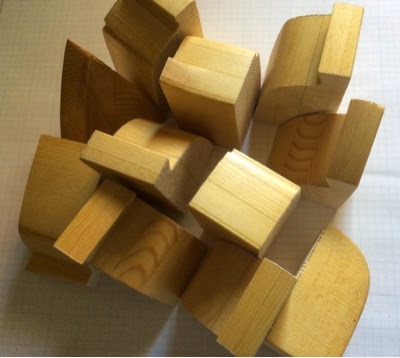
Here is a cut out station half section in three- D. The full half section you have to add up the cubic inches, then you go to the profile and work the numbers back. What you really do is just figure up one half and then just multiply by two. The black part on the wood block is what you are trying to calculate as close as possible. This is not hard. Once the whole boat is added up then you just divide 1728 by the numbers and that will give you your cubic feet. Then multiply by 64 lbs if going into sea water. This will give you your displacement , and hence your hull weight. 
Now if it's not enough to get to your desired draft then there are several ways to add or subtract to get too your design goals. By placing the hull skin on the inside of the lines you can subtract or by putting it out on the outside of the lines drawings you can add significant flotation. But making the boat wider adds a small amount as its just a sliver. At this point you can then start thinking about what to change . This I do on paper several times before I get to making my half hull. When I'am at the half hull stage I pretty much know what's up . Once the half hull is made I can then see it in three dimensions. Of course on computers today this can be done in a split second but feeling up the screen to caress your new creation is not so much fun.
I do all my designs at the scale of 11/2"=1' . This means that when gluing up 3/4" spruce planking each plank represents 6" of depth. The glue lines are what are called waterlines. This method of getting out a hull shape has been done for some of most beautiful boats ever created. It's also very easy to use this scale when lofting and building your design as you can read everything right off your tape measure . Nice big numbers. Using the metric system is way more accurate and easy to use but try getting Americans to change over. Sheesh.

Have fun...and any questions just email me....... Get going, start drawing

Saturday, January 10, 2015

Today is the good ole days


I've  had a good life. My mom and dad brought me up in a camping , hiking, pack mule traveling and eventually sailing cruising lifestyle. I was brought up with the adittude of if you wanted something you could not afford than build it yourself. Want to travel long distances on a Bycycle with an open time frame ..then do it on your own and not wait for a group to hang out with. This simple mind thought has  enabled me to just get things done and keep moving ahead. 
Looking back in time it's nice to have all these memories of places seen, things done and felt. Like the time when bycyling through the Grand Tetons in Wyoming at the age of 19 .I awoke in the fall morning haveing just slept in my down sleeping bag on top of a picnick table that night. The morning air was so crisp when poking my head out of this cacoon. My sleeping bag was completely frozen solid from my perspiration during the night. I was a popsicle outside with a warm inside.
I have been lucky many times in my adventures, from close calls from vehicles during my bycycle touring days, my hitchhiking adventures, hiking and backpacking trips to my singlehanded ,and offshore sailing trips. I've cheated death a couple times or as I like to put it I was not ready to die. So I never gave up and I'am still out here looking around the next bend to see what's there.
 
Today finds me in the Leeward island of Dutch St. Martin waiting for Rachel and our dog to fly in. This is a hectic place for a guy like me, but it's very dog fly in friendly so here I wait doing boat chores, some design commissions and ponder the present , the past and what the future holds in my sailing lifestyle.
The past is fun to think back on but it can never be recaptured. I still look back and forth to the present. We first sailed to St. Martin on the Hogfish 24 years ago with rachel and our young daughter Kalessin who was not yet one year old. We spent Christmas in Phillipsburg bay at anchor eating a can of smoked oysters and an avocado . We had sailed here to buy a duty free am radio. Life was so simple then. No email, Internet, GPS , engine, and not very many boats. We had just sailed from St. Bart's where we had splurged on a French pizza for $23.00 ! Yes it's always been very expensive there. A lot of miles have passed under our keels since then. lots of hard work getting ahead and staying ahead. This we have done as a simple couple not wanting more than we could afford making our kids a part of our rolling stone- vagabond life style. We just have kept on going with the many different opportunities that have come up and have delt with our daughters along the way finding entertainment when young and shore side schooling when older to get them involved in the locals life's. Both girls have excelled in  schooling both having won collage scholarships based on merit and grades. Growing up with a boat bum like me has not held them back. That was the good ole days.
Christmas Day 24 years go in St. Martin. Looking at a second main I'd made from Jim Melchors old Alerts mainsail.

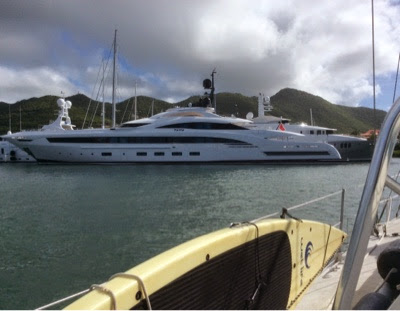
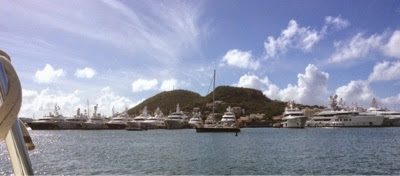
The present brings me to having moved out of the Simpson Bay Lagoon to re anchor off the beach in cleaner water and not so much harbor traffic. I had anchored in a small shallow part of the lagoon to get away from all the mega yachts, and just yachts in general as I keep thinking what would happen if the Hogfish Maximus where to get loose and drift down on a half a billion in yachts. In the Bahamas and other farther flung anchorages I'am used to putting out 2-3 anchors with lots of scope. I call my big fishermans my breaks. Then I feel good about going out on adventures in the skiff. Here there are so many yachts , sailboats ,wrecks and just stuff about there is simply not enough room today.
Right now I'am anchored off the beach in what looks to be shallow water but is about 8' which is shallow for most boats here. It's very rolly and bumpy but I can see the bottom kinda and I could get underway under sail if need be so I feel better here. 
Since arriving here I've met up with some old sailing mates of ours . Some have gone around the world 
 for the third time since last talking. Our talk now is mostly about what's up with finding work, local crime, the rising costs of clearing in and out of ports and how many f#%king boats are anchored through out the worlds anchorages today. Work is still easy to find if you have skills and work ethic . Local crime is always there , just lock stuff up. The costs of clearing in seems to be a racket now as all these islands are within sight of each other with the locals running their boats back and forth with no hassles but for us and all the day tourists what a racket. 

I realize I'am an old fart cruiser because the growing number of fiberglass huge 55'-70' sailboats being run by retired couples that have had no previous sailing experience is overwhelming . These boats are new and are worth from $ 350,000.00  to  a million upwards . By my count I have seen since sailing in here the past two weeks at least 500 + and counting and trying to avoid. That's just sailboats not power boats .What amazes me , boats don't appreciate like land can so where did all this wealth come from? Wow. 

Now I realize I'am an old fart under achiever. Ha I'll stay simple and keep my freedom.

The wind here is ever present with rain squalls lasting only a minute or two. The locals are still nice and fun to talk to. Eating a huge meal where the locals eat costs  $5.00 with a beer. At the water front bars the food goes up but alchole is still the cheapest thing around. I like to go in the evenings to the St. Martin yacht club bar and watch the yachts go through the bridge at 5:30 opening.

From my observations in life I have noticed that if you really want to show the world how much money you have to spend then you buy a MEGA yacht. A trophy wife are a dime a dozen, a huge house nobody ever sees, the jet you flew in on is parked with the 60 other look alikes at the airport.
 BUT in  a big ole mega yacht every one can see and when it squeezes through the Simpson bay bridge your captain will sweat but you can look down on all the minions waving up at you.

That's why I like taking my yacht through the bridge .

Milling about waiting for the bridge opening. How would you like to drag down on that yacht ? Ah... Sir I can fix that.
If I anchor 100' away in the same anchoage as these yachts and eat at the same places, er maybe and see the same sights and breath the same air.. Should I consider myself a one percenter?
My skiff is the third one ... No it's the white one... No ... What was its name again?
They're everywhere! 
Cueing up to get through, I went last... Safer
Going through. I have a friends condom boat on deck. They will be here soon to get it.
Now that's my kind of yacht ! Life is good , three big box wines, grocerys, and the whole crew in a 6' rubber condom boat.
 
It's a bit more hectic here now  but I have some change in my pocket and time to explore the new realitys of the present. 
I do have to confess, I have a trophy wife , and very nice house, a yacht and I do get high once in awhile so no jet ,who cares,
TODAY IS THE GOOD OLE DAYS !


The skiff list.....DETAILS

When staring to work on a flats boat skiff design you have to make up a weight list to know in advance what is going into and on your skiff. With this you get an idea what it's going to cost after sourcing out your parts and materials. Also if you can weigh each piece in advance then you can work with this on your new design. The thing to realize is that 98% of what you see on the below list is what will go on most all skiffs in the 12' -25' range and upwards. The only differences will be rub rails and engines.
Every thing else will be small sutilties. But it maters when you want to have a skiff weigh out all up in the 600-700 lb. range. It also matters in all kinds of other boats like high performance sailboats , multihulls and anything that wants to be fast with low horse power. So get a good scale and start weighing every thing and make your list. I would print up mine here for you but I can't find it right now.

When I was in business for myself I used  to make up these parts lists and price all my whole sale vendors against each other to see who had the best deals. This really played out well when building  over $400,000.00 in boats a month. Doing a one off today in your garage its best to find a freind in the business and see if you can get stuff from them at a good break in cost. Today on the Internet you can find all kinds of good deals but you have to take the time to do this. I am always looking through old boatyards for deals to be found. It helps to be thinking years or projects in advance.
This list is blurry here. If you can see it the prices are old but gives you an idea of what's up.
I will post all these drawings on my facebook photo page as they are real clear there.